
Shopping for a home (or binge-watching renovation shows) gets a lot easier once you can spot the difference between a Tudor and a Craftsman at 30 paces. This guide breaks down 33 of the most popular American house styles—what they look like, where they’re common, and the little clues (rooflines, windows, porches) that give each one away. Expect natural language, a pinch of humor, plenty of practical detail, and SEO-friendly clarity—without the keyword stuffing.
1) Colonial
Defining characteristics
- Symmetrical, rectangular façade with a centered front door
- Gable roof, multi-pane double-hung windows, simple trim
- Variants include British, Dutch, French, Spanish, and Colonial Revival
Spot it: Classic balance and a formal entry—often with simple pilasters and a transom—are your giveaways.
2) Cape Cod
Defining characteristics
- Compact, 1–1.5 stories; steep roof; central chimney
- Shingle or clapboard siding; dormers added in later revivals
Spot it: A small, sturdy rectangle wearing a big hat (steep roof) and sometimes two “eyebrow†dormers.
3) Saltbox
Defining characteristics
- Asymmetrical roof that slopes much farther on the back (“catslideâ€)
- Two stories in front, one in back; central chimney
Spot it: From the side, the long back roof is the tell.
4) Georgian
Defining characteristics
- Rigid symmetry and classical proportions
- Brick or stone, sash windows, paneled door with decorative crown
Spot it: Square or rectangular massing, hipped roof, and a centered, formal entry.
5) Federal (Adam)
Defining characteristics
- Refined, lighter interpretation of Georgian symmetry (c. 1780–1830)
- Fanlight over the door, sidelights, elliptical and Palladian motifs
Spot it: Graceful fanlight and delicate trim—think “classical, but on a diet.â€
6) Greek Revival
Defining characteristics
- Temple-like fronts, columned porticos (Doric/Ionic), wide entablatures
- Gable or hipped roofs; often white to mimic marble
Spot it: A front porch that moonlights as a miniature Parthenon.
7) Italianate
Defining characteristics
- Bracketed cornices, tall narrow windows (often arched)
- Low-pitched roofs; cupolas or belvederes on fancier examples
Spot it: Look up—ornate eave brackets are the calling card.
8) Gothic Revival
Defining characteristics
- Steeply pitched gables, pointed arches, decorative vergeboards
- Vertical emphasis with romantic, medieval vibes
Spot it: Pointed windows and fanciful trim that feels storybook.
9) Second Empire (Mansard)
Defining characteristics
- Distinctive mansard roof with dormers (adds a full attic level)
- Ornate cornices, sometimes iron cresting and central towers
Spot it: That double-sloped roofline is unmistakable.
10) Queen Anne (Victorian)
Defining characteristics
- Asymmetrical massing, turrets/towers, wraparound porches
- Decorative “gingerbread†trim; mixed materials and colors
Spot it: If it looks like a wedding cake, you’re close.
11) Shingle Style
Defining characteristics
- Continuous wood shingles over walls and roof; complex, flowing forms
- Low, rambling massing; porches and wide eaves
Spot it: A coastal classic that reads as one sculpted, shingled volume.
12) Tudor Revival
Defining characteristics
- Steep gables, decorative half-timbering with stucco or brick infill
- Tall chimneys, grouped casement windows, arched doorways
Spot it: Faux-timber “X’s†and a storybook roofline.
13) Craftsman (Bungalow)
Defining characteristics
- Low-pitched gable roof with wide eaves and exposed rafters
- Front porch with sturdy, tapered columns; hand-crafted details
Spot it: Deep porch living and honest woodwork—warm, human-scaled architecture.
14) Prairie School
Defining characteristics
- Horizontal lines, shallow hipped roofs with broad eaves
- Bands of windows; strong integration with the landscape
Spot it: Long, low profiles that seem to hug the ground.
15) American Foursquare
Defining characteristics
- Boxy 2–2.5 stories; hipped roof with central dormer
- Full-width front porch; typically four rooms per floor
Spot it: Efficient, no-nonsense cube with generous porch.
16) Ranch
Defining characteristics
- Single-story, long low roofline, open plan
- Attached garage, big picture windows, indoor-outdoor flow
Spot it: Horizontal sprawl with sliding doors to a patio.
17) Split-Level
Defining characteristics
- Staggered floors connected by short stairs (usually three levels)
- Efficient separation of living, sleeping, and rec spaces
Spot it: Entry at mid-level with quick steps up or down.
18) Mid-Century Modern
Defining characteristics
- Post-and-beam structure, open plans, walls of glass
- Low profiles, clerestory windows, indoor-outdoor blur
Spot it: Glassy, airy, and delightfully minimal.
19) International Style (Modernist)
Defining characteristics
- Flat roofs, ribbon windows, pilotis on some examples
- Open plan, free façade, minimal ornament
Spot it: Crisp white volumes and uncompromising simplicity.
20) Contemporary
Defining characteristics
- Current design language: mixed materials, large windows
- Asymmetry, sustainable features (green roofs, high-performance envelopes)
Spot it: Clean lines with modern performance baked in.
21) Traditional Farmhouse
Defining characteristics
- Simple gabled massing, horizontal siding
- Large or wraparound porch; practical, spacious layouts
Spot it: Straightforward forms with porch life front and center.
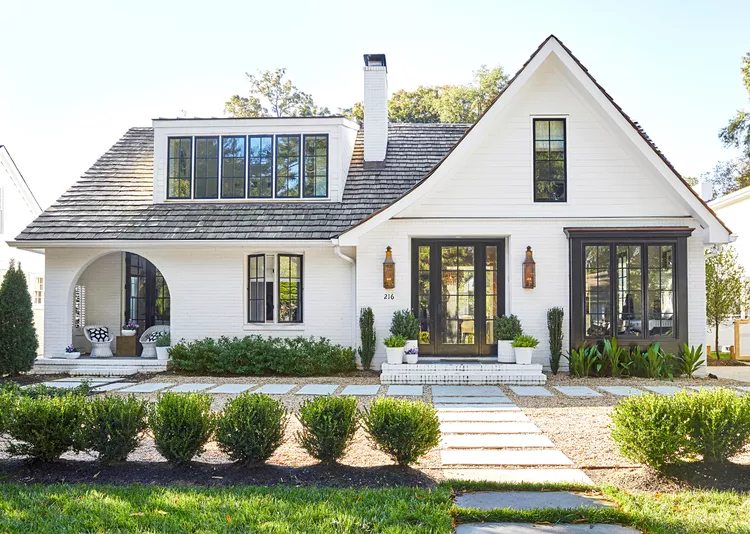
22) Modern Farmhouse
Defining characteristics
- Board-and-batten siding, tall black-framed windows
- Gable + shed roof accents; metal porch roofs
Spot it: The white-and-black contrast you’ve seen all over Instagram—because it works.
23) Mediterranean Revival
Defining characteristics
- Stucco walls, red tile roofs, arches and arcades
- Courtyards, balconies, wrought iron details
Spot it: Sunny stucco + terra-cotta + breezy outdoor rooms.
24) Spanish Colonial Revival
Defining characteristics
- White stucco, red clay tiles, arched openings
- Carved wood doors, iron grilles, cozy courtyards
Spot it: Romantic arches and red tile silhouette—especially in CA and FL.
25) Mission Revival
Defining characteristics
- Smooth stucco, shaped parapets, red barrel-tile roofs
- Arcades, deep eaves, occasional bell towers and quatrefoils
Spot it: Mission-inspired parapets and tile “visor†roofs.
26) Pueblo Revival (Southwestern)
Defining characteristics
- Adobe or stucco with rounded corners and thick walls
- Flat roofs with parapets; projecting vigas and latillas
Spot it: Earth-toned, softly rounded masses with exposed beam ends.
27) French Country / French Provincial
Defining characteristics
- Brick/stone, steep hipped roofs, tall casements with shutters
- Balanced façades with restrained classical details
Spot it: Elegant but not fussy—think country château lite.
28) Neoclassical (Classical Revival)
Defining characteristics
- Grand porticos with full-height columns and pediments
- Strict symmetry, monumental scale, minimal ornament
Spot it: A go-big return to Greco-Roman formality.
29) Art Deco / Streamline Moderne
Defining characteristics
- Deco: geometric motifs, vertical emphasis, stylized ornament
- Streamline: curved corners, horizontal banding, porthole or glass-block windows
Spot it: Either zig-zags and chevrons—or sleek, “ocean-liner†curves.
30) A-Frame
Defining characteristics
- Steep, triangular roof that often reaches near grade
- Lofts, big gable glass, simple post-and-beam structure
Spot it: A capital “A,†usually in the woods or by a lake.
31) Log Home / Cabin
Defining characteristics
- Stacked logs with visible corner notching; chinking between courses
- Rustic profiles, porches, and natural finishes
Spot it: The joinery (dovetail or saddle notches) gives away the craft.
32) Rowhouse / Brownstone / Townhouse
Defining characteristics
- Multi-story, narrow footprint; party walls on one or both sides
- Urban stoops; in NYC, brownstone sandstone façades are iconic
Spot it: Shoulder-to-shoulder rhythm along the block; a proud stoop.
33) Coastal / Beach House
Defining characteristics
- Elevated foundations, generous porches, deep overhangs
- Shingles or light siding; salt-air-friendly materials
Spot it: Big decks, bigger views, and details made for sun, wind, and spray.
How to Use Style Clues Like a Pro
- Rooflines: Mansard (Second Empire), gambrel (Dutch Colonial), catslide (Saltbox), red barrel tile (Mission/Spanish/Mediterranean).
- Window patterns: Bands (Prairie), multi-pane double-hung (Colonial/Federal/Georgian), casements with small panes (Tudor/Craftsman).
- Porches & columns: Full-height classical porticos (Greek/Neoclassical), tapered piers (Craftsman), wraparounds (Farmhouse/Queen Anne).
- Materials: Shingles (Shingle Style, Cape), stucco + tile (Spanish/Mediterranean/Mission/Pueblo), brick + carved stone (Italianate/Queen Anne urban).
Conclusion
Architectural styles are more than looks—they’re climate responses, cultural history, and lifestyle choices etched in wood, brick, and stone. Whether you’re house-hunting, remodeling, or just polishing your curb-appeal vocabulary, these 33 archetypes give you a fast way to identify what you love (and why). Save this list, and the next time you pass a porch with tapered columns or a roof with dormered eyebrows, you’ll know exactly what you’re looking at.
SEO Summary
meta_title: 33 House Styles & Their Defining Characteristics
meta_description: Learn how to identify 33 popular house styles—from Colonial and Craftsman to Modern Farmhouse—with clear, expert tips and real-world examples.
sapo: From Cape Cod simplicity to Tudor drama and Mediterranean flair, this expert guide decodes 33 of the most popular American house styles. Discover the rooflines, windows, porches, and materials that define each style, plus regional tips and pro tricks for telling look-alikes apart. Perfect for buyers, renovators, and design fans who want quick visual cues—and smarter curb-appeal decisions.
keywords: house styles, architectural styles, Colonial, Craftsman, Modern Farmhouse, Tudor Revival, Mid-Century Modern
500-Word Field Notes: Practical Experiences Identifying Styles
Walk a historic district with a builder, a preservationist, and a real-estate agent and you’ll hear three different love languages. The builder reads roof geometry first: a mansard means habitable attic space; a gambrel often signals Dutch Colonial; a long rear “catslide†roof telegraphs a Saltbox. Preservationists train the eye on original materials and joinery—tapered Craftsman columns sitting on massive piers, wood shingles that wrap uninterrupted around dormers on Shingle Style homes, or the way Prairie houses align window heads into long horizontal bands. Agents think in lifestyle terms: ranches offer one-level living; split-levels carve out kid-friendly dens; Queen Anne porches host the neighborhood.
When touring, start with three anchors: mass, roof, and rhythm. Mass answers, “Is this compact and symmetrical (Georgian/Federal)? Tall and vertical (Gothic/Queen Anne)? Long and low (Ranch/Prairie)?†Roof confirms lineage: steep intersecting gables (Tudor), flat or low-sloped with a parapet (Pueblo/International), or tiled hips and sheds (Mediterranean/Spanish). Rhythm is doors and windows: a centered door with evenly spaced double-hung windows screams Colonial DNA; casement groups tied with continuous mullion lines lean Prairie; asymmetrical window scattering plus a turret hints Queen Anne.
Next, interrogate the porch. A full-height classical colonnade suggests Greek or Neoclassical Revival; wraparounds with turned posts and spindlework point to Victorian exuberance; deep, beam-exposed porches belong to Craftsman bungalows. In warm climates, arcades and loggias (Mediterranean/Spanish/Mission) are functional cooling devices—these aren’t just decorative.
Materials help with region and era. Stucco + clay tile thrives in the Southwest and Florida; cedar shingles love the coasts; brick dominates East and Midwest urban cores; adobe/stucco with vigas is quintessentially Southwestern. Even details like iron cresting atop a mansard (Second Empire) or decorative half-timbering (Tudor) are style “accents†that rarely migrate between families.
For remodelers, honor the style’s hierarchy of cues: roof and window patterns are highest, then porch/entry composition, then trim and color. You can modernize a Colonial kitchen or add energy-efficient windows to a Craftsman, but if you flip the roof pitch or swap double-hung grids for frameless sliders, you’ll confuse the vocabulary. Similarly, a Modern Farmhouse looks right not just because it’s white; it’s the gable massing, black-clad windows, and restrained board-and-batten that sell the idea. Contemporary updates work best when they echo core proportions—e.g., using slim, dark frames on a Tudor to keep the vertical emphasis, or choosing smooth, flush eaves on a Mid-Century to preserve its knife-edge profile.
Finally, learn three quick tests. (1) The 10-second silhouette test: squint; if you still recognize the type (A-Frame triangle, mansard box, Tudor pitch), you’re set. (2) The porch-column test: tapered and chunky (Craftsman), turned and ornate (Victorian), colossal classical orders (Greek/Neoclassical). (3) The window-grid test: multi-pane double-hungs (Colonial families), grouped casements (Prairie/Tudor/Craftsman), ribbon or floor-to-ceiling panes (International/Mid-Century/Contemporary). Master those, and house-spotting becomes second nature.
About the Author
